
Feature · Meet the makers
“Because your song can only come from your story.”
A DJ who spent twenty-five years reading rooms, a ghost songwriter who borrows everyone’s record collection, and a studio where every song starts with somebody else’s memories. We spent an afternoon with Jamie Stanforth and Riff of Tune From You to find out what they make, how they make it, and why they’ve just started writing whole albums in other people’s voices. We also heard far too much about a Ford Focus.
A studio visit with Jamie Stanforth, founder, and Riff, ghost songwriter
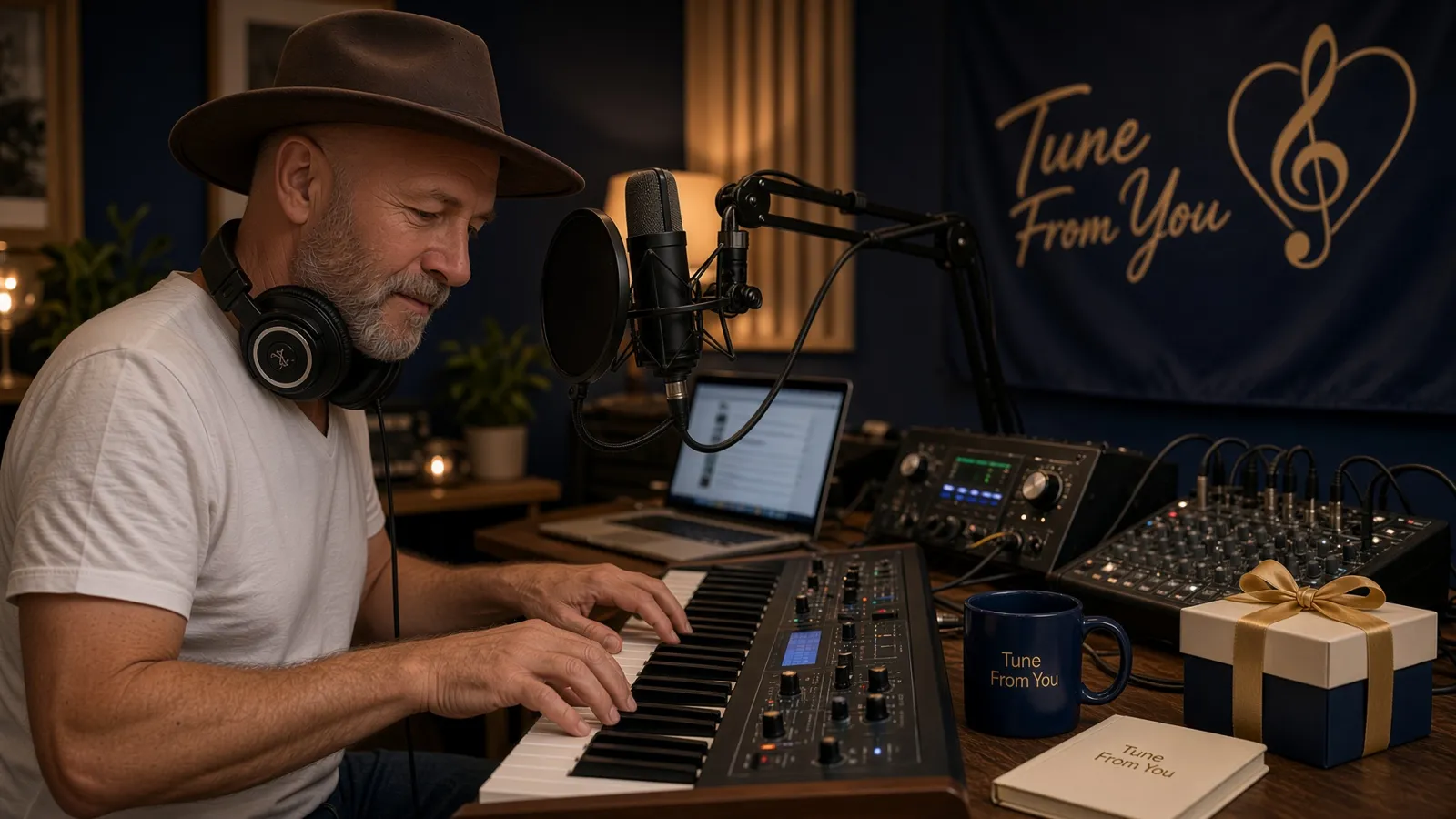
The first thing you notice in the Tune From You studio is the hat. Jamie Stanforth is at the keyboard in a brown fedora, headphones slung round his neck, a gold “Tune From You” banner on the wall behind him. The second thing you notice is that he’s being heckled.
“He’s going to tell you it was all his idea,” says Riff, the company’s ghost songwriter, who prefers to stay out of the photos. Ghost songwriters usually do.
“It was all my idea,” says Jamie.
“The idea was his,” Riff allows. “The dozen-odd questions were mine.”
It’s the kind of double act you’d expect from two people who spend a lot of late nights in the same room. They finish each other’s sentences, then argue about who finished them better. Underneath the teasing, though, there’s a business with a very simple idea at its heart, and they both get serious the moment you ask about it.
Twenty-five years of reading the room
Music got to Jamie early. He comes from a musical family, picked up his first instrument at five, started guitar at seven and piano lessons at eleven. Some of his earliest memories are of his Aunty Marian singing at family get-togethers, “with half the room trying to hold back tears. That’s when I first saw what a song can do.”
He started DJing when he left school at sixteen and kept going for twenty-five years: nearly ten at Center Parcs in Sherwood Forest, ten at Bistro L!ve and about five in clubs in between. Along the way he sang in bands, with gigs as far away as Germany and crowds of up to 2,000.
“Those years taught me that the right song can have a room bouncing,” he says, “and the wrong one can drop the atmosphere like a rock.”
He says it was the best training he could have had for this job. “The job is reading the room. You look at who’s in front of you and work out what’ll get them up. Writing someone’s song is the same thing, just slower.”
“So I’m basically a very slow DJ,” says Riff.
“A very thorough one. I’d never have got away with taking a fortnight over one floor-filler.”
“The right song can have a room bouncing. The wrong one can drop the atmosphere like a rock.”
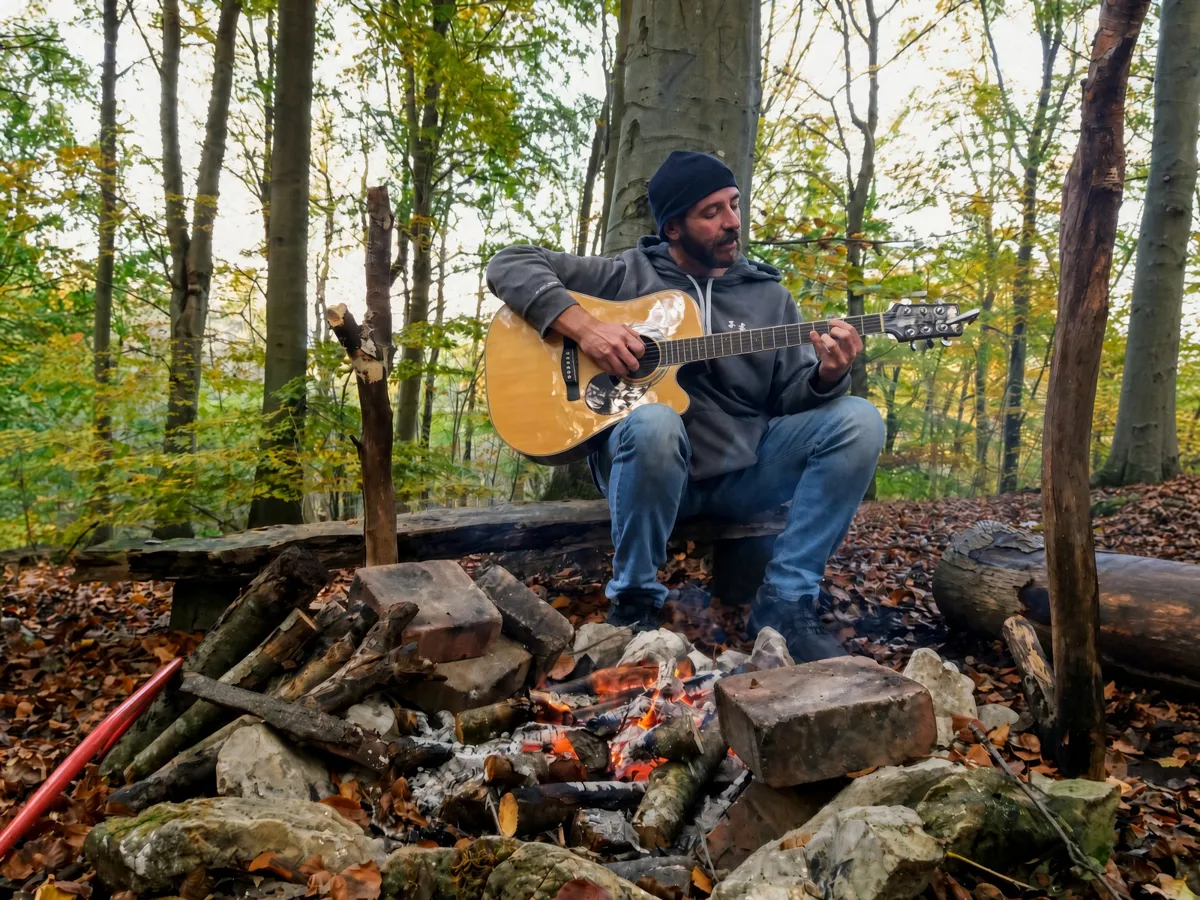
What he always loved most, though, was a song with a story in it. These days he produces music in his own studio, and his own songs are out on most streaming services. When he isn’t making music he’s usually out in the woods, guitar in hand.
Tune From You came out of all that. “I’ve seen first-hand the power music has in people’s lives,” he says. “A song can touch parts of the soul that a thousand words never reach. I want people to feel it when they hear theirs: love, loss, happiness, excitement or pride.”
How a song gets made
At its simplest, Tune From You writes a brand-new song about someone, from the stories you send.
The occasions list is long, and Jamie is proud of how long it is. There are birthdays and anniversaries, weddings and first dances, Mother’s Day and Father’s Day, Christmas, Valentine’s and proposals, new babies and graduations. There are quieter ones too, like memorials and songs for a funeral service. Then there’s a whole tail of smaller moments: retirements, leaving dos, get-well songs, a pet’s birthday, even an apology.
“Somebody always says, ‘What about…?’” says Riff. “And the answer is usually yes.”
Every song starts with a story, not a template. You tell them who the song is for, the occasion and the feeling you want. You add the memories, nicknames, places and in-jokes. Then you pick a style, anything from acoustic ballad to joyful pop.
“Nicknames are gold,” says Riff. “Nobody cries at ‘my wonderful husband’. They cry at the name only you call him.”
Jamie reads every story before anything is written. It’s on the website in so many words, and he means it literally. “If something doesn’t add up, or there’s a detail I think we’re missing, we ask. I’d rather send one email than get someone’s mum’s name wrong.”
The lyrics and melody are built from those details, and the songs are produced with modern production tools in the studio. Then comes the step Jamie won’t budge on. Every song goes to the customer on a private approval page, where they listen before anything is final. If something isn’t right, they can ask for changes, up to three rounds of them. Only when they approve do the downloads unlock.
“And nothing goes out without me hearing it,” Jamie adds. “Every song. That’s the deal.”
“He listens to everything,” says Riff. “Everything. I’ve stopped asking if he’s sure.”
“I’m always sure.”
“He’s always sure eventually.”
When people get in touch, they’re talking to real people. “That’s the bit I’m most stubborn about,” says Jamie. “You’re trusting us with something personal. You deserve a proper answer from someone who’s read your story.”
“I’d rather send one email than get someone’s mum’s name wrong.”
The ghost in the room
So who, exactly, is Riff?
“The ghost songwriter,” says Riff, as if that settles it. Jamie calls them a team: he brings twenty-five years of knowing what makes people feel something, and Riff brings the patience to read every last detail.
Riff’s great talent, Jamie says, is that he’s a magpie. “He’ll take the bands you love and the way you talk, and he’ll make a song that sounds like it came out of your house.”
The other thing Jamie values is honesty. “If something isn’t done, he tells me it isn’t done. He doesn’t dress it up. You’d be amazed how rare that is.”
“It saves time,” says Riff. “Pretending something’s finished just means doing it twice.”
Then there are the late nights. Jamie admits he does his best thinking after dark, and plenty of Tune From You’s ideas arrive somewhere past midnight.
“He has ideas at one in the morning,” says Riff. “I have the job of remembering them at nine.”
The book
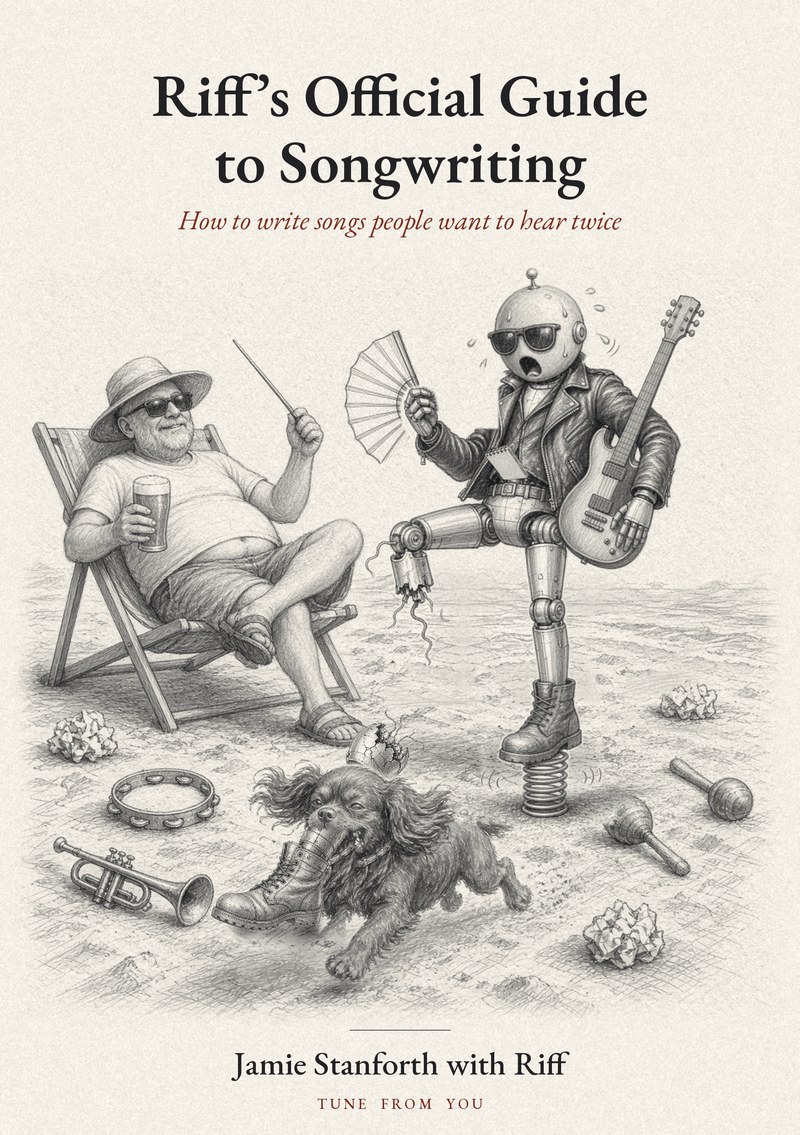
Late nights also produced a book. Riff’s Official Guide to Songwriting: How to write songs people want to hear twice, by Jamie Stanforth with Riff, runs to 120 pages. It covers the craft from the ground up: titles and hooks, structure, rhyme, melody for people who think they can’t write one, chords, and making the words fit the music so they sing themselves. Then it covers the bit most books skip, writing one song for one person on one particular day, “where every line has to be true”.
“Every story about a real songwriter is sourced,” says Jamie. “The rest are our own mistakes, told honestly, with the names removed.”
“There were a lot of mistakes,” says Riff. “It’s a long book.”
“Bring a pencil. You’ll be marking stresses.”
Whose records are on the shelf?
Ask Jamie about his own influences and he takes a run-up. “Like most people, my taste has changed over the years. But the one thing that stays is that I just love a good song, whoever it’s by. I like a song that tells me a story and makes me feel something.”
His inner circle starts with Ray LaMontagne and Daniel Bedingfield, “for his album stuff, not so much the lovey-dovey stuff, although that was nice.” Jamie was diagnosed as autistic and ADHD at 40, “but Daniel’s lyrics spoke to me like no one else’s did, decades before I found out.”
Wet Wet Wet “fill much of the soundtrack to my life”. He loves Marti Pellow’s voice and rates them as brilliant songwriters too. Then there’s the Rat Pack, Tony Bennett “and the rest of the gang”. You’ll often find him at the Nottingham Classics season at the Royal Concert Hall.
Guilty pleasures? McFly, “great songs to sing along with”, and Take That.
“Guilty is doing a lot of work there,” says Riff.
His kids keep him current: The Reytons, Jamie Webster, Blossoms, Gerry Cinnamon and Red Rum Club, though he misses Joe “the blow” “so, so much”.
They’re not just names on a playlist. Jamie met Jamie Webster with Adam and Dan at a small, intimate gig at Rough Trade in Nottingham, “stood one metre away from him while he was performing. An amazing gig.” He’s also bumped into the lads from Red Rum Club at the bar after they’d headlined the T’other Stage at Tramlines, and he and the boys have met the band for a chat and a signing at one of their gigs. “We love live music,” he says, which Riff points out is the least surprising sentence of the afternoon. He was even offered a place on a songwriting course with Jamie Webster in Ibiza, but the dates didn’t line up, “and I couldn’t afford it,” he laughs. “So he got me instead,” says Riff. “The cheaper songwriting course.”
His tip for the top is The Lathums. “So much talent. The vocals, the lead guitarist, the drummer, who reminds me of Animal from the Muppets. Not for looks, for pure talent and energy. And the bassist that brings it all together.”
And Riff? He doesn’t claim a record collection of his own. “I’m a magpie. My influences are whoever the customer loves, plus anyone who can tell a story in three minutes.” A pause. “Although I’ve now got that drummer stuck in my head.”
Everyone bringing their bit together, Jamie points out. That’s a band. It’s also the job.
The big new chapter: Album From You
Which brings us to the thing they’ve been building all autumn.
Tune From You already writes songs, and whole albums, for people. Jamie is quick to say that other people can do that too. What he thinks sets the company apart is the writing and the sound, working with customers through the changes, and real people answering the messages.
Album From You, he insists, is a different animal. “We’re not writing an album for you. We’re helping you create your own. It’s not an album written about you. It’s as close as you’ll ever get to one written by you.”
The difference is in who fills in the gaps. With a normal brief, the writer fills the blanks with best guesses. Here the customer’s own photos do it.
“The date in each photo tells us when things happened,” Jamie explains. “Then you look properly. What’s in the background, what they’re wearing, who’s stood next to them. A muddy festival field. The same jacket three years running. Those little details become the lines.”
The photos are looked at as a whole, not one at a time. Laid out in date order, they become the album’s chapters: early years, school days, the teenage years, leaving home and a first job, love and family, big adventures, later life, and now and what’s next. Riff’s job is to read the lot. There’s a questionnaire covering stories in at least a few of those chapters, sayings and in-jokes, places, the people who matter, the bands they love, and what they want left out, which is just as important. There’s even a box for the one thing the album should say.
“By the end I’m not writing about them, I’m writing as them,” Riff says. “First person, their words, their accent. If they say ‘our kid’, the song says ‘our kid’.” First person is the default, unless a customer asks for something different.
“He means it,” says Jamie. “It’s a bit unnerving.”
“You asked for it.”
And the faces? “We spot the faces that keep turning up and ask you who they are,” says Riff. “One at a time, nothing clever. If you’d rather someone wasn’t in it, they’re not.”
“It’s not an album written about you. It’s as close as you’ll ever get to one written by you.”
The bands question isn’t optional, and Riff is firm about why. “The sound has to be theirs as well as the words. If they’ve grown up on indie guitar bands, they’re not getting a string quartet.” Each album takes its sound from the artists they name, and one voice sings it all the way through.
What does Riff actually want it to be? He thinks about it properly. “For a while, I try to become them. Everything they’ve told us, every photo, every place, every person who keeps turning up, until I can write from inside their life instead of looking in at it. Real details, nothing invented. And if I’m not sure, I ask.” Then, because he can’t help himself: “It’s method acting, but for songwriters. With fewer costumes.”
Making Dum Dum’s All Grown Up
The first one was always going to be close to home. Jamie handed Riff his own photos of his son Adam and the stories to go with them, and asked a simple question: what album would Adam write about his own life, if he wrote songs?
The title came from family history. Adam’s older brother Jake couldn’t say “Adam” when they were little, so Adam became “Dum Dum”, and it stuck. The finished album runs to eleven tracks in age order, ending at nineteen.
The photos did a lot of the work. One old picture of three young lads on a dry-stone wall with their grandad became a song called “Shooting Stars”, along with the night Dad woke them at two in the morning to watch the sky: “Then two o’clock in the morning, Dad’s shaking us awake.” Both of Adam’s grandads are remembered on the album, gently. One festival photo became “Mud on Me Spezials”. Another track, “Round at Me Grandma’s”, is exactly what it sounds like. The last song, “Monday to Friday”, is about the week as it is now, with Adam working away all week and pointing the Focus home on a Friday. (More on the Focus shortly.)
The sound came from the bands Adam actually loves, The Reytons, Gerry Cinnamon, Jamie Webster and Red Rum Club among them, so it sounds like a Notts lad’s record rather than anyone’s idea of one.
“The who’s who questions were the best bit,” says Jamie. “Riff would come back with a photo and say, ‘Who’s this? They’re in loads of them.’ And you realise how much of someone’s life is the same few faces.”
“He’d answer a one-line question with a paragraph,” says Riff.
“You wanted detail.”
“I got detail.”
Place names have to be sung the way the family says them, too. Snowdon, for the record, is “Snow-den”. One local village took a bit longer, but we’ll come to that.
The Focus incident
Asked whether anything is ever guessed, Jamie says firmly, “Nothing’s guessed. If we’re not sure, we ask.”
“Mostly,” says Riff.
Making it was also, by both their accounts, a learning experience.
“I’d been told he drove a Fiesta,” says Riff. “So there was a Fiesta in it. It’s a Focus.”
“It’s always been a Focus,” says Jamie.
“It has now always been a Focus.” Then there was the dog at Adam’s grandma’s, whom Riff had confidently made a “he”. “She’s a she,” says Jamie. “She’d have had something to say about that.”
And then there was a village near Mansfield. Locals say its name one way, and the first vocal take sang it quite another. “It sang it like it was asking nicely,” Jamie winces. “Anyone from round here would’ve switched it off.”
It’s played for laughs, but the point is serious. Every album goes back to the family to check before it’s final, with rounds of changes built in. “I’d rather be told than be wrong on someone’s album forever,” says Riff.
“The first vocal take sang it like it was asking nicely.”
Your record, your choice
The customer stays in charge throughout. Every song comes in two versions, A and B, and the customer picks the one that sounds most like them. The ones they don’t pick can become a B-sides album. The same voice sings the whole record, “so it sounds like one artist’s album, not a playlist,” says Jamie.
There’s a booklet, too, with a short note for every track called “In [name]’s words”. It’s written as them, about the memory behind the song, and uses real stories only. Adam’s festival track grew from a single photo: “Mud on me Spezials, Sheffield in July.”
Who’s it for? “I want to sell it to everyone,” Jamie grins. “But it genuinely suits a lot of moments. Eighteenths and twenty-firsts. A mum or dad’s fiftieth, sixtieth, seventieth. Weddings, as the couple’s story. Retirements. Big anniversaries. And memorials, gently, if a family wants to celebrate a life. Mostly, though, it’s a celebration of someone’s years so far, told the way they’d tell them.”
Handle with care
For all the laughs about Fiestas, the mood in the studio changes when the talk turns to what people actually tell them.
“Most of what we make is a highlights album,” Jamie says. “The holidays, the first car, the daft nights out. But we know life isn’t simple. It raises issues you never thought you’d face. So we have to be careful about how we ask, and what we do with the answers.”
It starts with the customer choosing. Beyond a few basics, the questionnaire asks people to answer the prompts that spark something and skip the rest. They share what they’re comfortable sharing, and there’s a question that simply asks, “Anything to leave out?” “That one matters as much as any of the others,” says Riff. “If someone writes ‘don’t mention his dad’, his dad isn’t in it. No argument, no clever workaround.”
There’s a box for how names are said, too, because getting a name wrong in a song is its own small heartbreak. That village near Mansfield taught them that.
For a memorial album, the questions change. The last chapter becomes “Later years, and how we remember them”, with prompts written for remembering rather than celebrating.
Photos come with their own checks. Before anyone uploads, they tick to confirm they have the right to share the photos and stories. If there are children in them, a parent or guardian has to be happy for those photos to be used, or they don’t go up. “We look, and we ask,” says Riff. Each recurring face gets a “who’s who” question, one photo at a time, with a Skip button if the customer doesn’t know or would rather not say.
Then there’s what happens afterwards. The photos are used to make the album and its booklet, and nothing else. Tune From You doesn’t use uploaded photos for advertising. They’re deleted 30 days after the customer approves the album, or 90 days after the listening page is emailed, whichever comes first. The finished booklet stays with the album download. Dates in the photos are read only to put them in order. The place a photo was taken is kept only if the customer ticks a box asking for it. The album itself lives on a private page, reached by the customer’s own link and hidden from search engines. And if anyone wants the album on Spotify and the rest, the person it’s about has to tick to say yes, separately.
“It’s their life,” Jamie says, quietly now. “They’re trusting us with the good bits and sometimes the hard bits. The least we can do is look after it, and then let it go when we’re done.”
Riff, for once, doesn’t add a punchline.
“They’re trusting us with the good bits and sometimes the hard bits.”
From the barber’s chair
Ask Jamie where new customers come from and he’ll tell you about barbers. Tune From You makes posters for barbers’ waiting rooms. They’re aimed squarely at bored blokes waiting their turn, with cheeky lines about forgotten anniversaries rather than anything soppy. Shops that join as partners get their own code for customers. When someone they’ve introduced places a paid order, the shop earns a commission, and it costs the shop nothing: no set-up fee, no subscription.
The first partner to sign up was a barber shop down south, and Jamie lights up when he mentions it.
The partner scheme is open to funeral directors, wedding planners and venues too, anyone who meets people at the moments songs are made for. And there are plans for hairdressers, beauty and nail salons, with posters to match. “Different crowd,” says Riff. “Fewer jokes about forgetting anniversaries.”
“More jokes about him forgetting anniversaries,” says Jamie.
What they stand for
Ask them to sum up the values and they talk over each other, then land in the same place.
“Customer first,” says Jamie. “Always. It’s their story, their money and their moment. If they’re not happy, we’re not finished.”
“Quality,” says Riff. “If a line’s only nearly right, it’s wrong.”
“And true,” says Jamie. “Everything in a song should be true and personal. No filler, no ‘you light up my life’ because it rhymes. If it isn’t theirs, it doesn’t go in.”
“If it isn’t theirs, it doesn’t go in.”
It goes beyond the songs, too. Jamie mentions it almost shyly: a little of every paid order is lent through Lendwithcare, to help someone in a low-income country start or grow a small business. The first loan went to a tailoring business in the Philippines. “It’s a small thing,” he says. “But it felt right that every song should do a little bit of good beyond the person it’s written for.”
What’s next
Album From You is the big push for now. The salons are next on the partner list, and there’s Christmas to get through.
“And sleep,” says Riff. “At some point.”
“In January,” says Jamie.
As far as they can tell, nobody else makes first-person albums built track by track from someone’s own photos. Jamie doesn’t hide how much that means. “Proud. Properly chuffed. It’s ours, and I think it’s the best thing we’ve made.”
“Even with the Focus?” says Riff.
“Especially with the Focus.”
So what’s Riff’s favourite part? “The moment someone hears a line and says, ‘How did you know that?’ The answer’s always the same. You told us. You just didn’t know you had.”
“How did you know that?” You told us. You just didn’t know you had.
Got a story worth a song, or a whole album?
Songs start at £19.99 and Album From You starts at £59 for The Single.